About the Project
The “Virtual Interview Room” was created out of a desire to help children prepare for an interview and to increase their protection against secondary victimization in criminal proceedings. This is especially important for children who live far from the place of the interview and are unable to come to court in advance to see the room where the interview will take place.
Thanks to the website “wirtualnypokojprzesluchan.pl”, a child, either independently or with the help of a parent/guardian or another trusted person, will be able to calmly and interactively explore the place where the interview will take place and obtain the most important information about the interview itself.
The value of this project also lies in the fact that its content will be adapted for children with intellectual disabilities, and that the option to listen to the website content by pressing the “speaker” icon will also be available to children who have not yet learned to read, as well as to blind users.
The rationale behind the “Virtual Interview Room” project and the creation of this website is the fact that a child who learns that they will be interviewed often experiences fear and stress, helplessness, lack of confidence, or even anger. The procedural situation in which a minor finds themselves is often difficult for them to understand and may feel threatening, while their intellectual and socio-emotional development creates additional difficulties in communicating with unfamiliar adults, for example during the interview. Children are most often afraid of the offender (meeting them, being confronted with them, being threatened by them, or fearing that the offender will be angry with them and that giving testimony will lead to rejection by the offender), punishment (the child fears being punished for taking part in something they were forbidden to do, such as going through a park where they encountered the offender and were harmed, despite their parents clearly forbidding them to go there), difficulties during the interview itself (the child fears forgetting something, making a mistake, not knowing the answer to a question, not understanding the questions, or not knowing what will happen if they need a drink or want to use the toilet), and worsening of the family situation (they fear that if they talk about what happened, they may make the family situation worse and be rejected).
Every year in Poland, more than 13,000 people are interviewed in Child-Friendly Interview Rooms, including 10,000 children interviewed under Articles 185a and 185b of the Polish Code of Criminal Procedure, and 3,000 persons interviewed under Article 185c. Interviewing a child is one of the most difficult evidentiary activities in criminal proceedings, both for the interviewer and for the child. This is because such an activity creates a risk of secondary victimization, and its effectiveness depends largely on the child’s ability to relate their experiences and on their preparation for participation in the interview.
One way to avoid secondary victimization, increase the ability to provide precise and comprehensive statements about experienced events, and alleviate possible negative consequences related to participation in the interview is to prepare the child for taking part in it. The concept of “preparation for participation in an interview” does not have a legal definition; however, based on the available literature, it should be understood as a meeting of the minor (and, if possible, also the parents) with an expert psychologist or another appropriately trained person before the interview, consisting of two stages: education and psychological support. Providing the minor with knowledge about the interview, its course, and what is expected of them may give them a greater sense of security and can positively affect the quality of their testimony.
Research on child interviews in Poland, the results of which can be found in academic studies, indicates that children are generally not prepared for interviews in advance, and if an earlier meeting with an expert psychologist does take place, it is usually held just before the interview begins, in the corridor, if the psychologist is able to make time for it.
Since there is no well-developed practice in Poland of preparing a child for an interview, even a substitute form of preparation may be to see the Child-Friendly Interview Room in which the interview will take place and to obtain at least basic information about what the interview looks like and what rights the child has during this procedure.
Although the Regulation of the Minister of Justice of 22 September 2024 on the method of preparing and conducting interviews under Articles 185a–185c and Article 185e of the Polish Code of Criminal Procedure, as well as on the requirements to be met by rooms intended for conducting such interviews, makes it possible for a child to go to court and see the interview room, and although the annexes to that Regulation contain the most important information about this activity, we cannot ignore the fact that today children are particularly receptive to content published on the Internet, through which they may more willingly absorb information presented in a visually accessible way.
Moreover, although the possibility for a child to go to court and see the interview room is an interesting solution, we must bear in mind that many children will not benefit from it, because they would have to go there accompanied by a parent or another adult, and the parents may not be interested in such a visit, for example due to lack of time or their own problems connected with the crime concerned in the proceedings. In addition, if the place of the interview is significantly far from the child’s place of residence, especially for children living in rural areas, parents may have neither the opportunity nor the time to travel to court with the child.
The implementation of the “Virtual Interview Room” project gives children, especially those who struggle with problems at home or who are lonely and left to cope on their own with the experience of a crime and the planned interview, a real opportunity to prepare for participation in the interview and to obtain information about this procedure in an interactive and child-friendly way, even without leaving home. The project also helps parents, who may feel confused and frightened by the fact that their child is to be interviewed by the court.
In addition, the “Virtual Interview Room” project makes the justice system more child-friendly and shows that in Poland the needs of children are being recognized, with efforts being made to reach them in an accessible and understandable way. The website may be used both by practitioners and for training purposes by judges, prosecutors, psychologists, law students, and trainee judges, prosecutors, legal advisers, and advocates, as well as by persons acting as child representatives. It may also be used by psychologists who work with children and include interview preparation within the scope of psychological assistance they provide. Moreover, attorneys for minors or child representatives who wish to help a child prepare for an interview may also use this website.
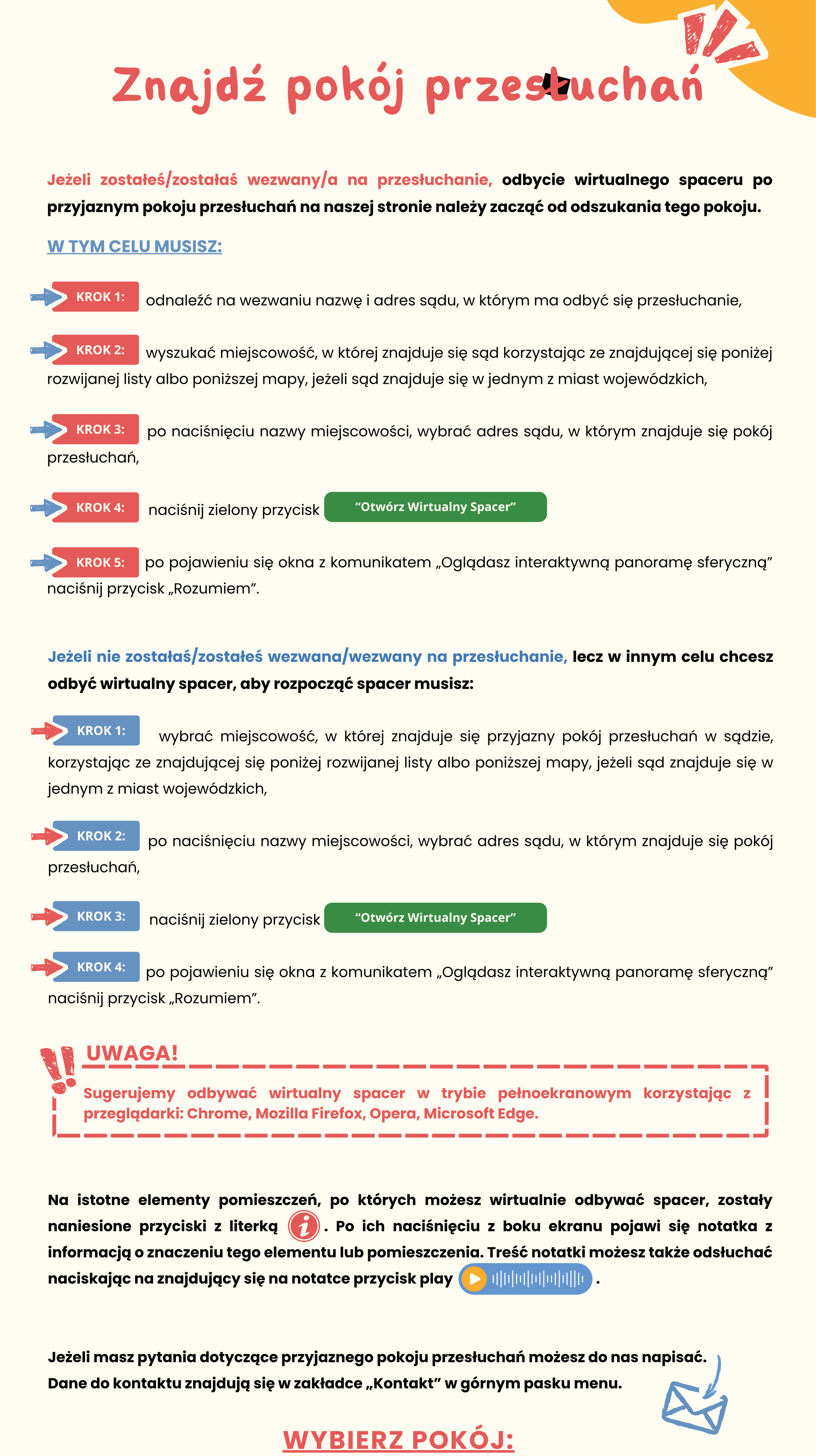
Thanks to the website “wirtualnypokojprzesluchan.pl”, a child, either independently or with the help of a parent/guardian or another trusted person, may calmly and interactively explore the place where the interview will take place and obtain the most important information about this procedure. During the virtual tour, special buttons marked with the letter “i” will appear on the key elements of the room’s equipment. After clicking such a button, a note describing the given element will appear and will be read aloud by a voice-over both in Polish and in English.
The tour is completely free of charge and does not require registration or the creation of an account. It may be repeated many times without any time limits. The Child-Friendly Interview Room is also used by judges when hearing a child in civil proceedings; therefore, the “Hearing the Child” tab contains content presenting the most important information about this procedure, addressed mainly to parents and guardians, but also to judges and other participants in the proceedings.
The “Virtual Interview Room” project was created with the aim of supporting children’s rights and protecting them against the negative effects of participation in criminal proceedings. The website was created with the involvement of judges, legal advisers, academics, as well as students and graduates of the Faculty of Law and Administration of Maria Curie-Skłodowska University in Lublin. All persons involved in the creation of the website are presented in the “Our Team” tab. The project regulations are available for download below.
Attorney-at-law PhD Katarzyna Osiak-Krynicka
Project Coordinator